Independent researcher · verification of AI-derived science

Andrey Pluzhnik

I build instruments that check what machine learning claims about physics — and publish the measurements, the calibration floors, and the failed runs alongside the successes. Work produced with an AI agent under one hard rule: the agent never gets to mark its own work as verified.

ORCID 0009-0005-5660-2603 GitHub @AndreiPLK Zenodo archive

Published work

preprint + machine-checked proof · 2026-09-03

A floor under Newton's inequality: four fifths, never less

Newton said the staircase never has a dent; he never said by how much. For the list of numbers that decides whether a deformed string amplitude stays physical, the margin is exactly 4/5 — sharp, for every case, proved in five machine-checked pieces. And a 1988 conjecture nobody had cited in thirty-eight years, proved over most of its range, with the open corner stated honestly. Two adversarial reviews on release day; one derivation caught and repaired, both reports in the package.

2026-09 MIT 627-rung ladder + 3 certificates, each independently validated Sibuya 1988: j ≤ 1000, θ ≤ 0.9, ≤ 802 missing
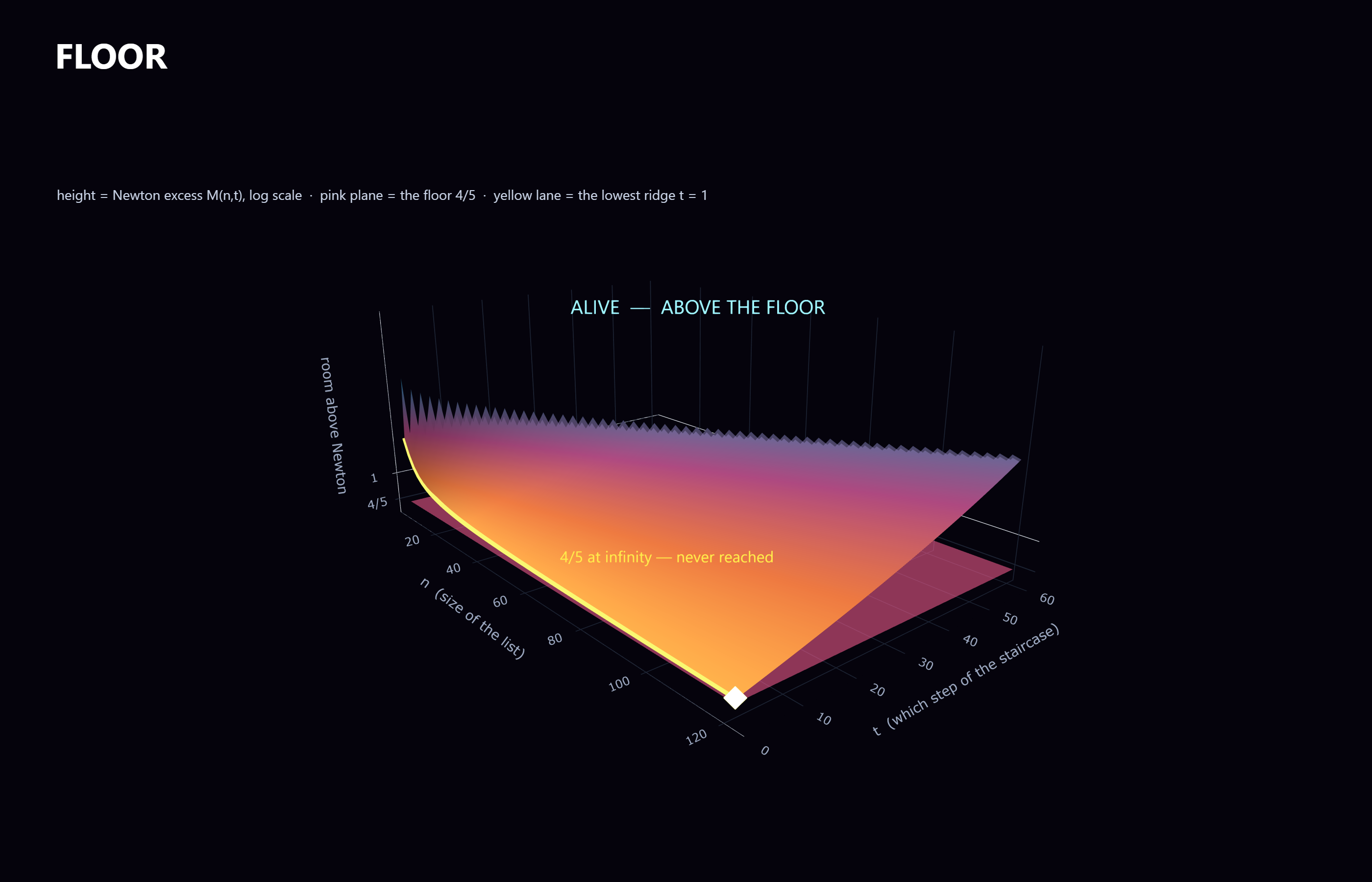
The Newton excess surface over the (n,t) plane with the floor 4/5 drawn beneath it; the surface never dips through.
lab note · 2026-08-17

One day of being wrong productively

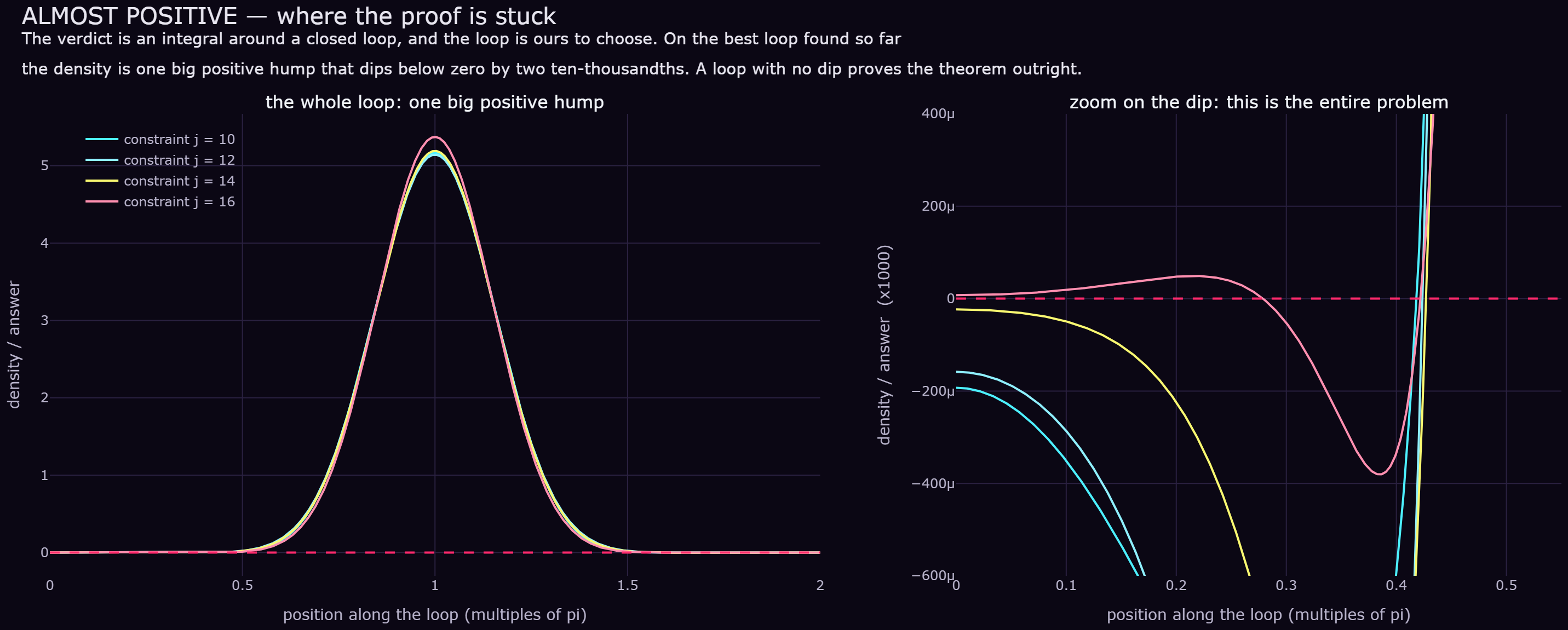
The problem shrank tenfold, five of my own errors were caught before they left the building — one looked briefly like the collapse of the main theorem — and by evening the exact missing mathematics had a name. Unpolished on purpose.

28 hypotheses killed1,634 certified cells227,040 exact checks
Almost positive
preprint + machine-checked proof

Checking is not knowing: the blades, proved

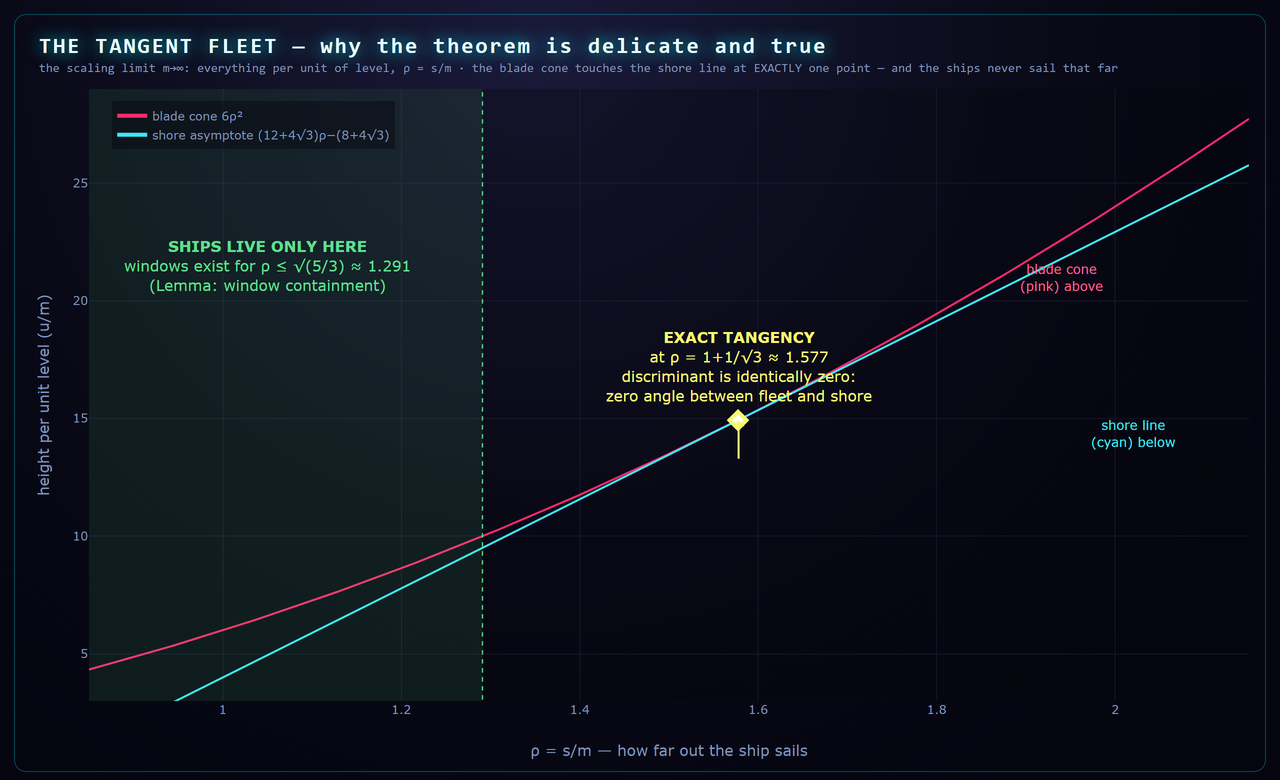
Sequel to the master formula. What three million exact checks suggested is now a theorem: no kill-window of the second knife ever cuts below the shore — even though at infinity the fleet of blades sails exactly tangent to it. 1,047 certificates, two independent provers, and one real bug caught by adversarial review, fixed, and told in the paper.

2026-08 MIT + CC BY 4.0 1,047 certificate cells, both provers exit 0 exact tangency at ρ=1+1/√3
The blade cone touching the shore line at exactly one tangency point, with the window zone ending strictly before it.
counterexample + dependency-free check

A statement with strong numerical support turns out to be false

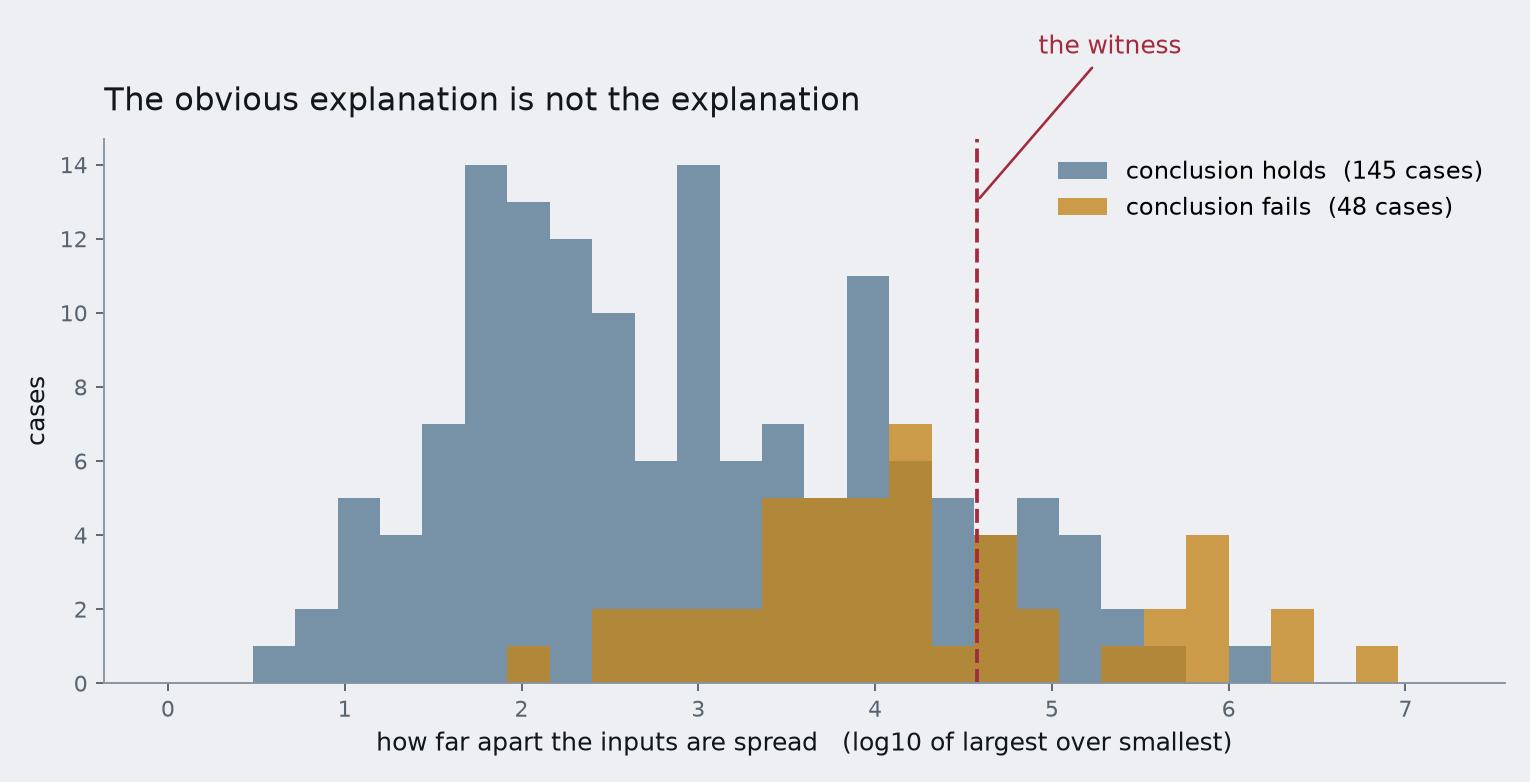
Some sequences are log-concave: each term beats the geometric mean of its neighbours. A stronger property asks the same of the sequence of ratios. The question was whether that survives a particular averaging. It does not — five numbers break it, twice, well inside the range in question. The margin is written out as an exact fraction, so the refutation is checkable by hand.

2026-09 MIT + CC BY 4.0 48 of 193 inputs break it verified four independent ways
Two overlapping histograms of how far apart the inputs are spread: the cases where the statement holds and the cases where it fails overlap almost entirely, so spread alone does not explain the failures.
preprint + exact-arithmetic code

Every way gravity can fail, in one formula

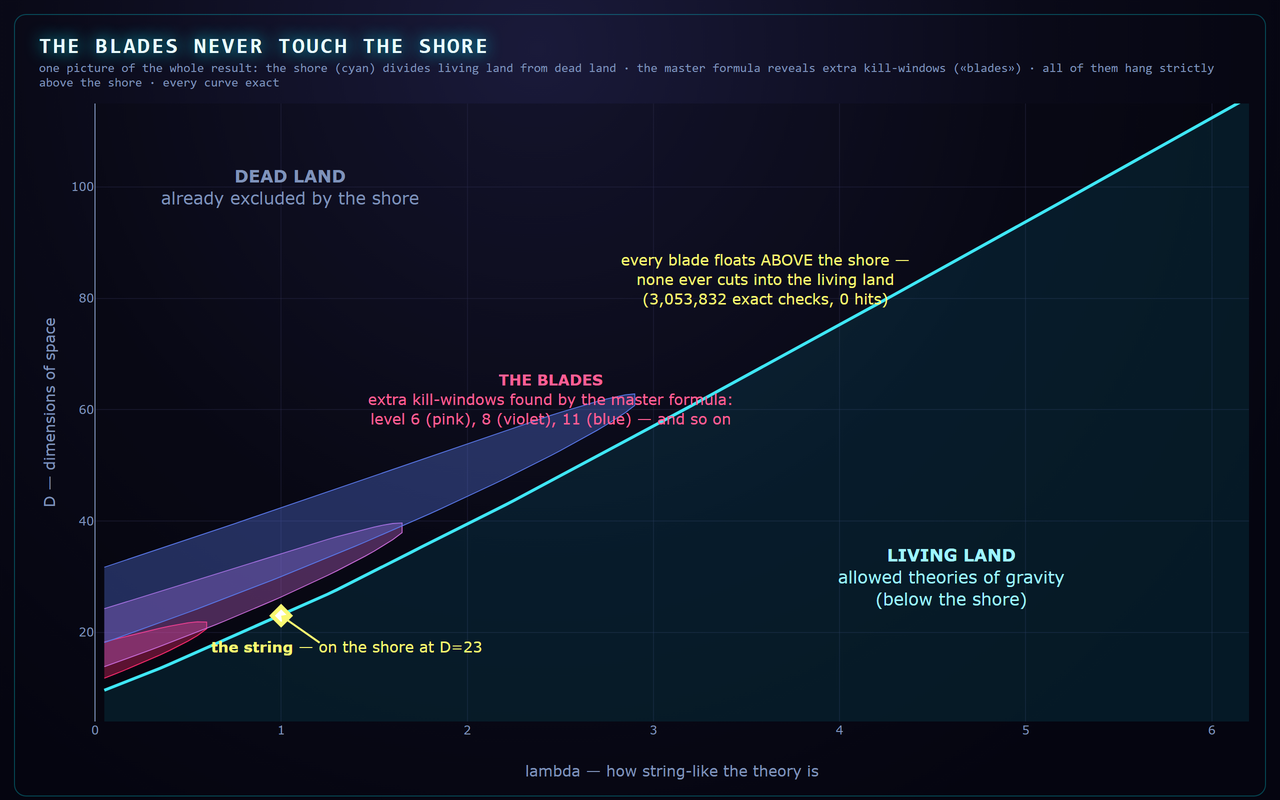
Sequel to the shore paper. One closed formula gives the sign of every Regge-trajectory partial wave of the CHR graviton family; each extra constraint turns out to cut a finite “window” of dimensions that floats strictly above the shore. Derived, adversarially reviewed, and checked on 3,053,832 exact points: not one cut into the allowed region.

2026-08 MIT + CC BY 4.0 3,053,832 exact verdicts, 0 hits independently re-derived theorem
Blade-shaped kill windows floating strictly above the cyan shore line dividing living land from dead land; the string sits on the shore at D=23.
preprint + exact-arithmetic code

The shore of closed-string gravity

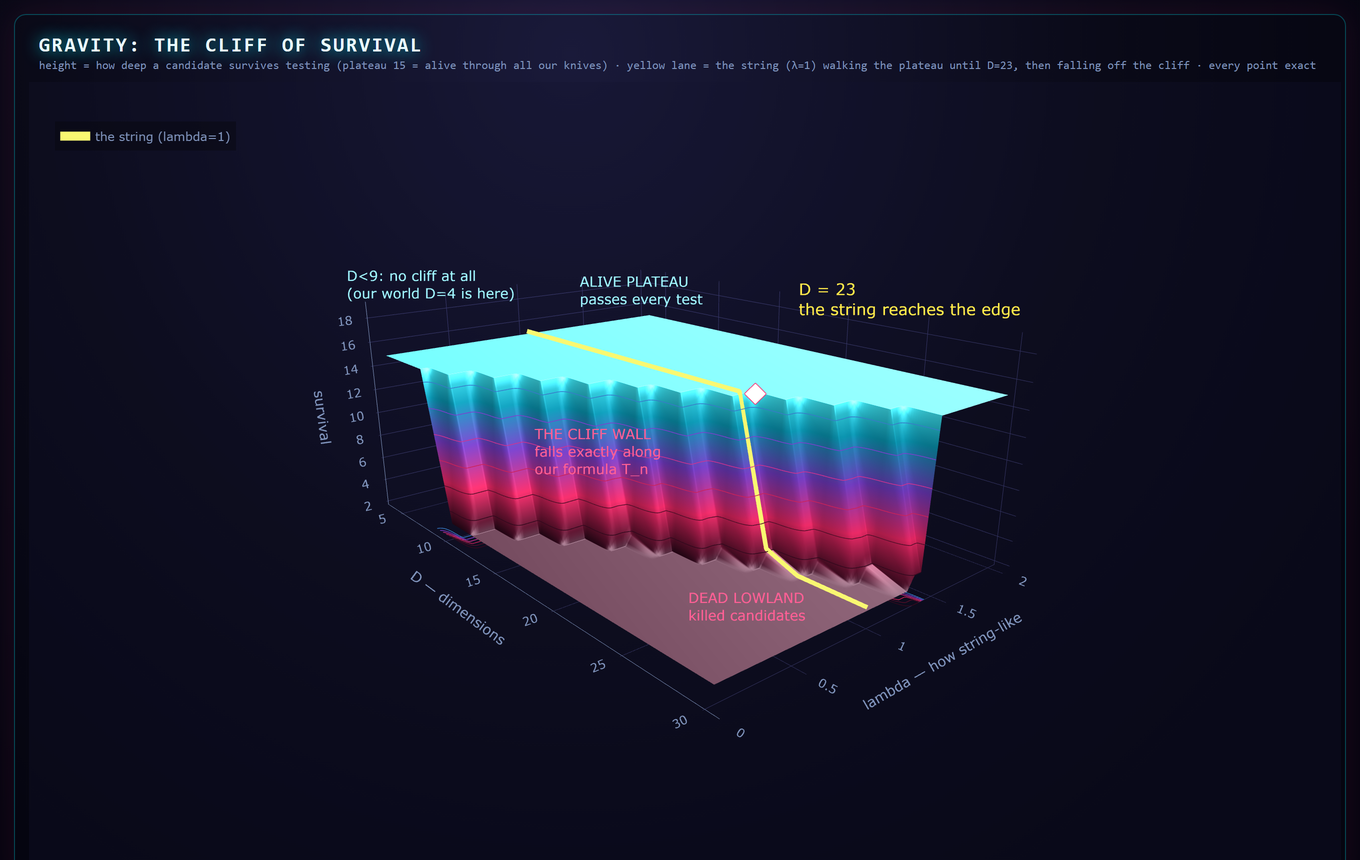
Graviton amplitudes containing textbook string theory are killed, as spacetime dimensions grow, by one quantum rule: probabilities can never be negative. This work derives the killing boundary as a formula. It switches on at 9 dimensions, passes exactly through the string at 23, and straightens onto D = (12+4√3)λ. In our own four dimensions, nothing in the family dies at all.

2026-08 MIT + CC BY 4.0 494/494 exact verdicts, 0 alarms independently re-derived theorem
3D landscape: cyan plateau of surviving gravity candidates, a cliff wall falling along the derived formula, and the string walking the plateau to the cliff edge at D=23.
preprint + exact-arithmetic code

The island of string theories has edges

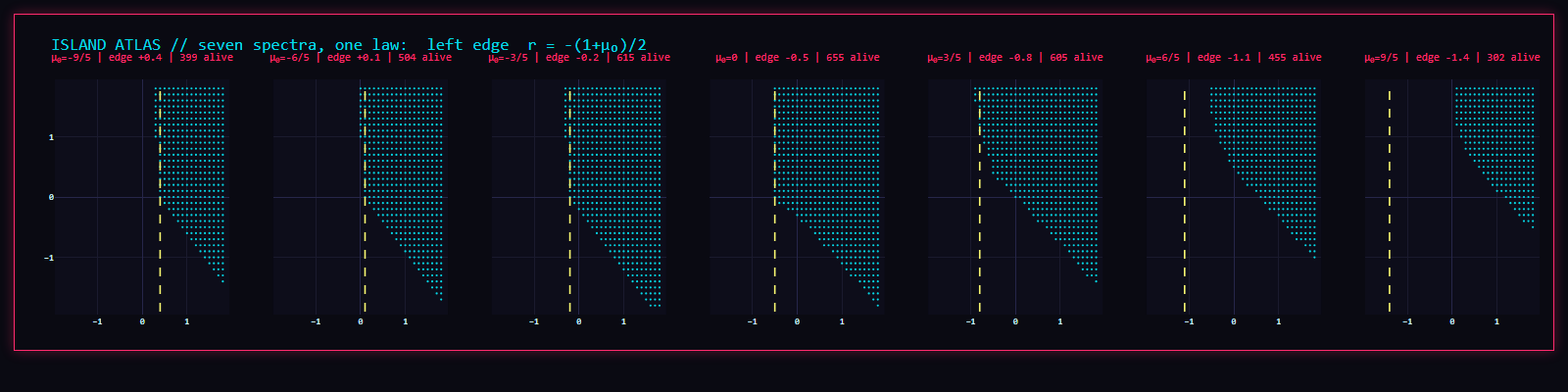
The allowed island of Veneziano-type string amplitudes was known only as a computer scan. This work derives its boundary in closed form: an exclusion edge valid in every dimension, explicit curves for the rest, and a clock for how fast q > 1 deformations die. 11,994 exact verdicts, zero unexplained mismatches; adversarially reviewed; matches a rival method where they overlap.

2026-08 MIT + CC BY 4.0 from-scratch validation: PASS 5/5 DOI 10.5281/zenodo.21934462
Seven positivity islands for seven mass shifts, each with the same analytic exclusion edge overlaid.
software + reproducibility study

Checking an AI's black holes

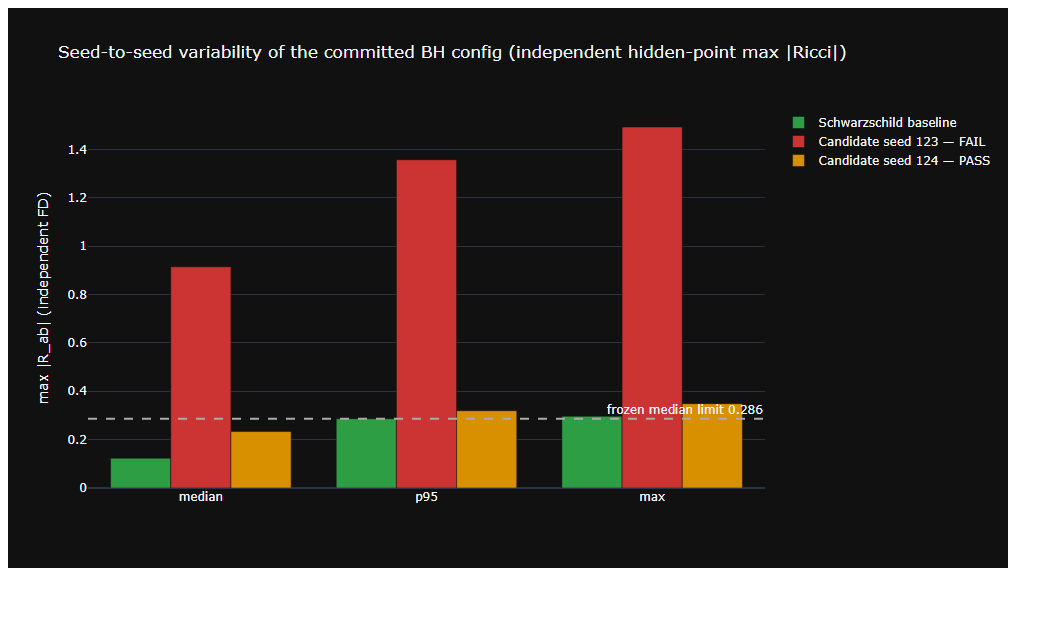
An independent curvature evaluator for machine-learned spacetimes, and the first audit run with it: five retrainings of a published neural black-hole configuration. The exotic geometry reproduced five times out of five; the Einstein equation itself held in two of five — and the model's own loss could not tell the difference.

2026-08 DOI 10.5281/zenodo.21915627 MIT 20 known-answer tests, CI on Linux/Windows
Bar chart: five training runs of the same configuration; two pass the pre-frozen vacuum limit, three fail, while their training losses barely differ.
In progress

How did the universe grow its first supermassive black holes?

JWST sees billion-solar-mass black holes less than a billion years after the Big Bang — seemingly too big, too early. Next up: an open, honestly-calibrated testbed that runs every proposed growth channel through one instrument and checks them against the public JWST catalogues. Small papers, published as they land.

Also queued: JOSS submission of the verifier (eligible 2027-02, after six months of public history — their rule, a fair one).


Everything here traces to files with recorded SHA-256 checksums, failed runs included. AI involvement is disclosed in full in each repository. andypluzhnik@gmail.com