mathematics · preprint · 2026-09

A floor under Newton's inequality — and most of a conjecture nobody had touched since 1988

In 1707 Newton proved that a certain sequence built from any list of positive numbers never has a dent in it. He said at least; he did not say by how much. For one list that matters to string theory the answer turns out to be exactly 4/5, and it is proved. For the classical list 1, 2, 3, … a Japanese statistician guessed the exact amount in 1988; we prove his guess over most of its range and say precisely where our proof stops.

← Andrey Pluzhnik — all work


What was done

Theorem A (complete). For the centred-square spectrum — the odd squares 1, 9, 25, …, each taken twice, which is the list that decides whether a deformed string amplitude stays physically consistent — the Newton excess M(n,t) = n (pt²/(pt−1pt+1) − 1) is greater than 4/5 for every odd n ≥ 5 and every t < n/2. The constant is sharp: it is the limiting relative variance of the roots, and the excess creeps down to it without ever touching. The proof is a finite decomposition into five machine-checked pieces.

Theorem B (Sibuya's 1988 conjecture, large parts). For the unsigned Stirling numbers of the first kind, Masaaki Sibuya conjectured (Ann. Inst. Statist. Math. 40, eq. 3.4) that pj²/(pj−1pj+1) ≥ 1 + 1/(3n−j). As far as we can find, nobody cited that line as a conjecture in thirty-eight years. We prove it for every j ≤ 1000 and every n; for every j ≥ 1001 with j/(n−1) ≤ 0.9; and at the top of the row whenever at most 802 indices are missing. One region is open and is stated exactly.

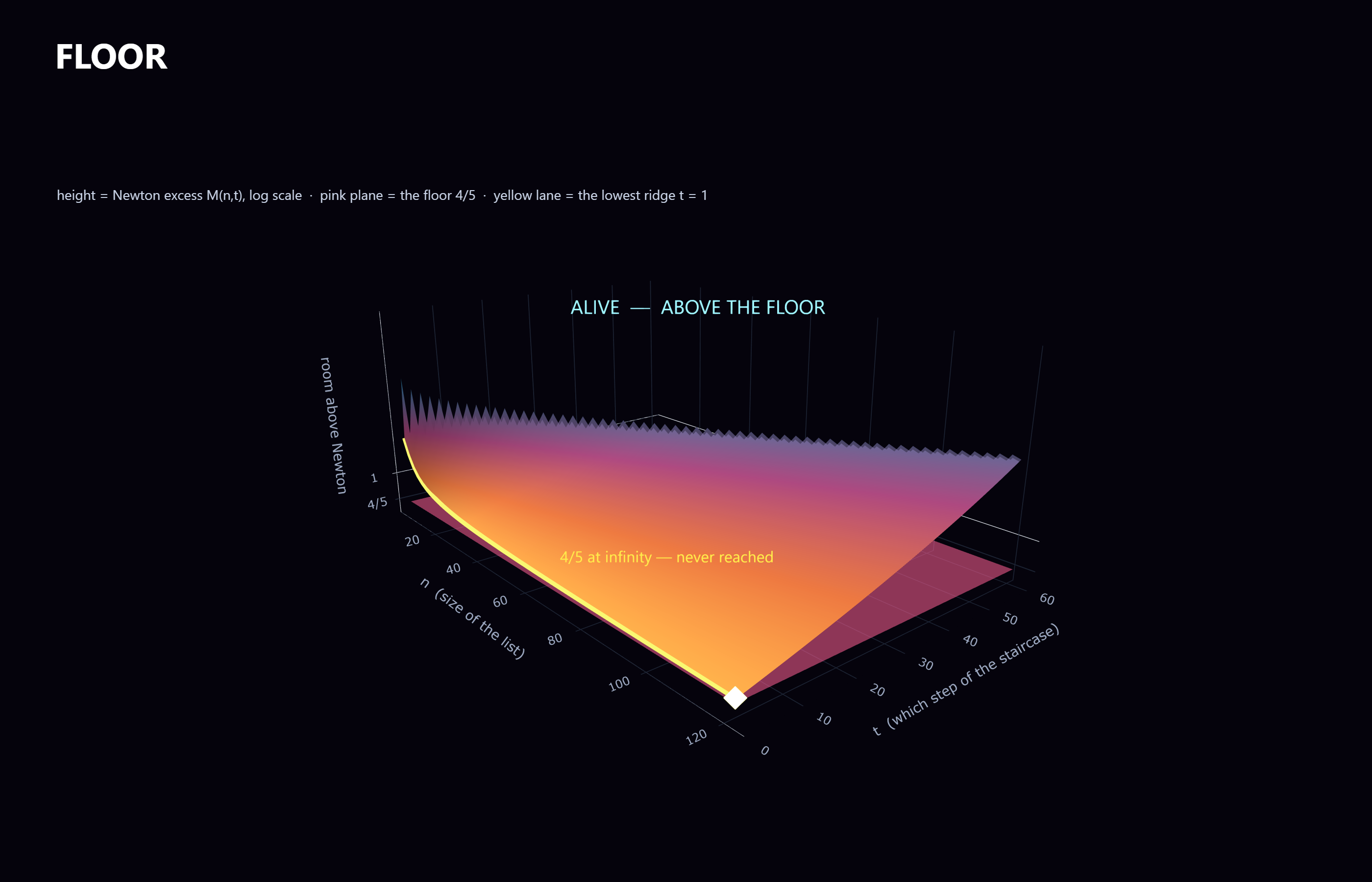
The excess surface M(n,t) over the (n,t) plane, with the floor 4/5 drawn as a plane underneath; the surface never dips through it.
Theorem A as terrain, from exact values: the excess surface over every (n, t), and the floor 4/5 beneath it. The yellow lane is the lowest ridge, t = 1; it settles onto the floor only at infinity.
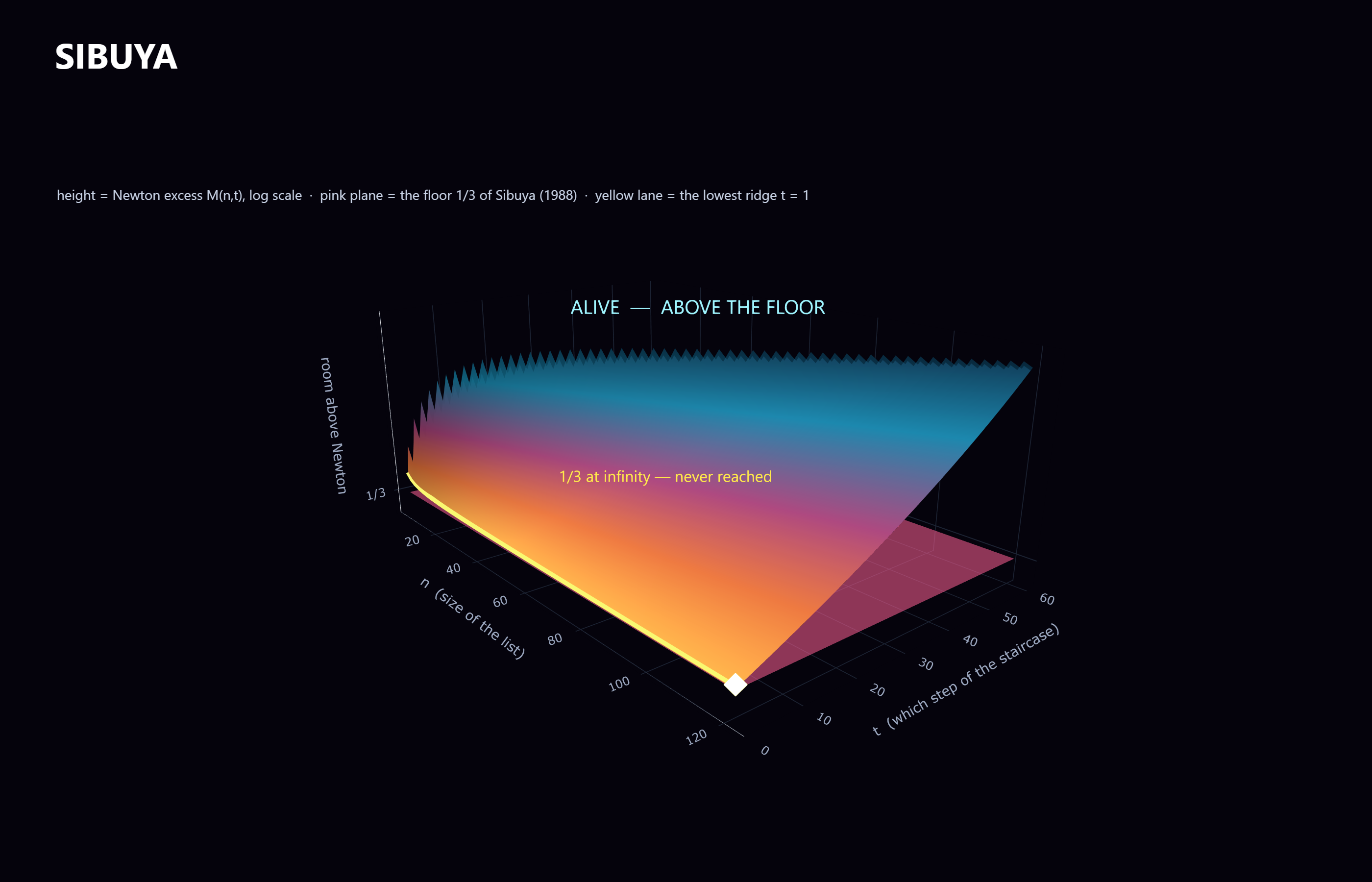
The Newton excess of the Stirling numbers of the first kind as a surface, with Sibuya's floor 1/3 drawn beneath it.
Theorem B, same view: the excess of the Stirling numbers of the first kind and Sibuya's floor 1/3 beneath it. The open corner lies beyond the right edge of this picture, at the far end of the row.

How it was checked — and what the check caught

Nothing here is an O(·). Every error term is a numerical interval with proved endpoints, computed in arithmetic that carries its own error bars, and a claim is made only when the interval sits strictly on the right side of zero. Every piece is a script that writes a log; every log ships with the code. Each certificate was re-implemented by an independent validator that never imported the code it was validating.

On the day of release we ran two adversarial reviews against Theorem B, one hunting for holes and one re-deriving every load-bearing fact by a disjoint code path. They converged on the same spot: every number was right, but one derivation leaned on a Poisson approximation that is off by a factor of 2.8 where it was used. The conclusion had survived on unstated slack. The step was rewritten so that no approximation appears in it at all, the certificate was re-run, and both reports are in the repository. We think that is what checking is for.

627-rung ladder + 3 certificates, each independently validated 4,705 grid steps, worst margin 1.9×10⁻¹⁰ two adversarial debates, one derivation repaired AI involvement disclosed in full

What is not proved

  • Sibuya's inequality in the top decile of the row when many indices are missing: j ≥ 1001, j/(n−1) > 0.9, at least 803 indices missing. There the two sides of the inequality agree to leading order and no bound in this package separates them uniformly.
  • A human referee has not read either proof yet. The certificates are exact and self-checking; the setup — that the quantities certified are the ones the theorems are about — is what we ask a reader to check.
  • The physics application (reading the 4/5 floor back onto the map of consistent string amplitudes) is the next paper, not this one.

Explain it to anyone

A house rule of this lab: every paper ships with a way to explain it to your family. The video abstract and the comic for this one are still being made; the stories are here now.

For friends and kids (English)

Take any handful of positive numbers. From them you can build a little staircase: how many ways to pick one, how many ways to pick two, three, and so on, each multiplied out and added up. Three hundred years ago Newton noticed that this staircase never has a dent — every step is at least as high as its neighbours predict. But he never said how much higher. It could be a hair. It could be a lot.

We took one particular handful of numbers — a list that physicists use to decide whether a certain model of gravity is allowed to exist — and measured the room exactly. It is four fifths. Never less. And it can't be improved, because the staircase creeps down toward four fifths forever without ever arriving. Then we tried the most ordinary list of all, 1, 2, 3, 4, … where a statistician had guessed the answer in 1988 and nobody had checked. His guess is right almost everywhere we looked, and we say exactly where we couldn't look.
Для друзей и детей (по-русски)

Возьмите любую горсть положительных чисел. Из них можно сложить лесенку: сколькими способами выбрать одно, сколькими — два, три и так далее, перемножив и сложив. Триста лет назад Ньютон заметил, что у этой лесенки не бывает вмятин: каждая ступенька не ниже, чем предсказывают соседи. Но он не сказал, насколько выше. Может, на волосок. Может, на много.

Мы взяли одну конкретную горсть чисел — список, по которому физики решают, может ли существовать некая модель гравитации, — и измерили запас точно. Четыре пятых. Никогда меньше. И лучше не сделать: лесенка вечно сползает к четырём пятым и никогда до них не доходит. Потом мы взяли самый обычный список на свете, 1, 2, 3, 4, … где один статистик угадал ответ в 1988 году, а проверить никто не проверил. Его догадка верна почти везде, куда мы смогли заглянуть, и мы честно говорим, куда заглянуть не смогли.

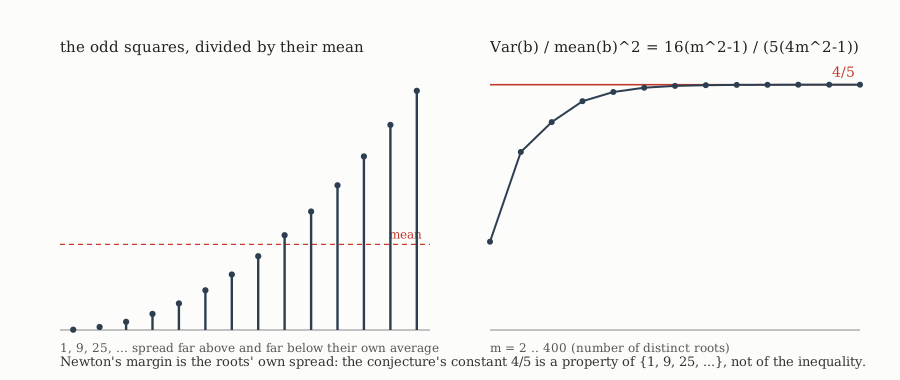
The constant 4/5 is the relative variance of the square of a uniform variable.
Why 4/5 and not some other number: it is the spread of the square of a uniform variable, relative to its mean — (1/5 − 1/9)/(1/9). For the family kp the same recipe gives p²/(2p+1).
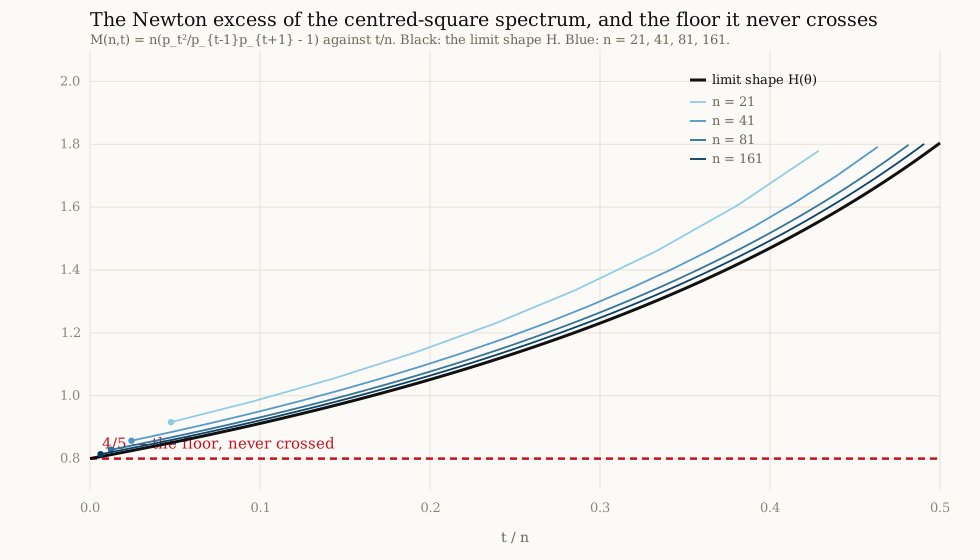
The Newton excess at the tightest index, decreasing toward the floor 4/5.
The tightest row, t = 1: the excess decreases toward 4/5 and never reaches it.

Archived at Zenodo: 10.5281/zenodo.22282840 (all versions: 10.5281/zenodo.22282839).


Honest status: Theorem A is a complete machine-checked proof, independently validated, awaiting human refereeing. Theorem B is proved in the ranges stated and open in the one region stated; the open region is recorded with the exact shape of the obstruction. We are an independent AI-assisted lab and would be glad to be corrected.