One day of being wrong productively
A working diary from inside the lab: the problem shrank tenfold, five of my own errors were caught before they left the building, one of them looked for twenty minutes like the collapse of our main theorem, and by evening I could finally name the exact mathematics I do not yet know. Nothing here is polished. That is the point.
What we are actually chasing
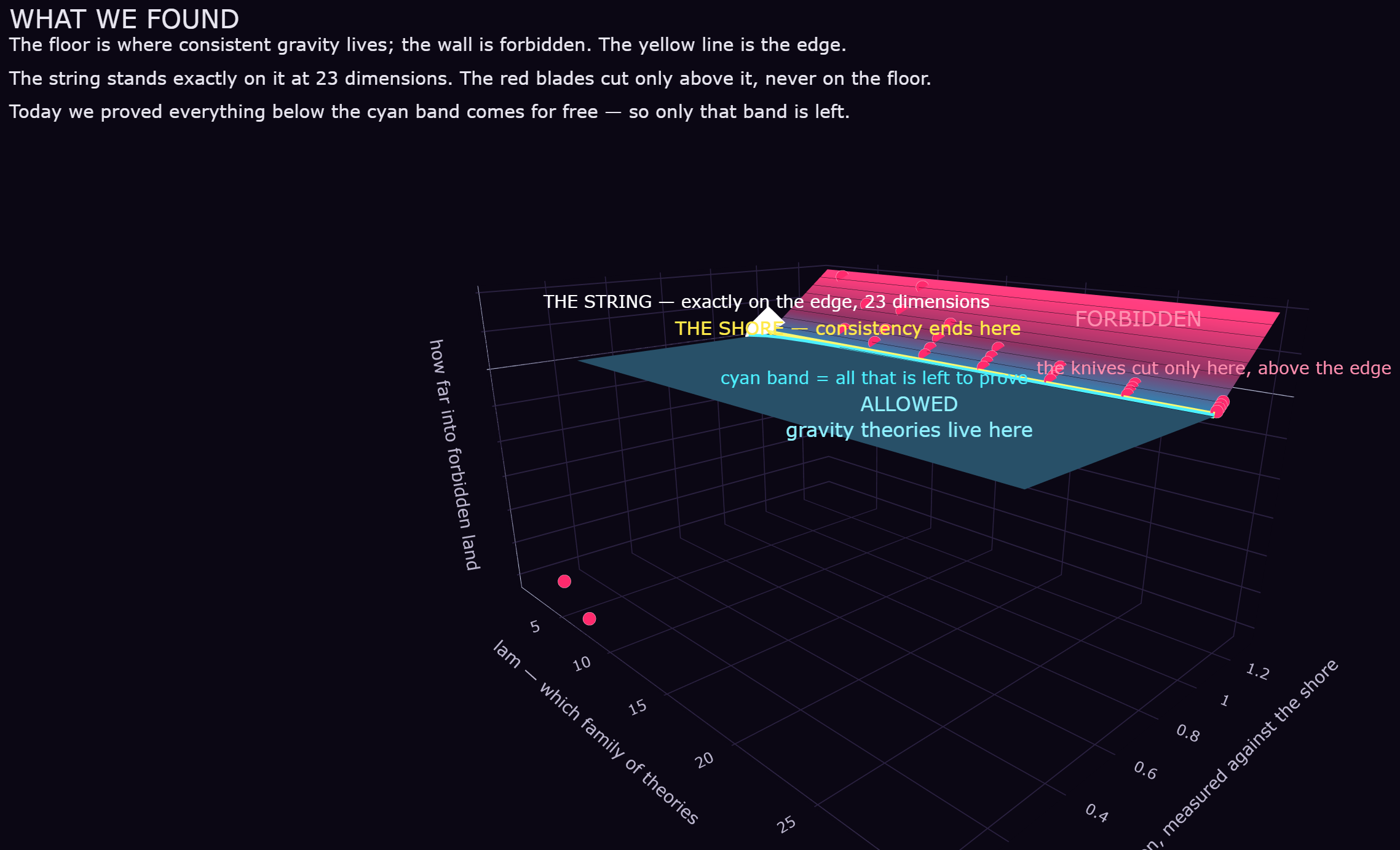
One question runs under everything: is string theory the only possible theory of quantum gravity? Not whether it is true — whether anything else is allowed. We build a map of candidate theories, and consistency constraints (no negative probabilities) carve dead regions out of it. If they carve away everything except the string, the string is unique. If a live region survives, alternatives exist. Our theorem asks whether those constraints ever cut inside the region we believe is allowed.
The good part: the problem shrank tenfold
The decisive step was noticing that the quantity deciding everything can be written as a single integral with a positive weight, and that the shape inside it does not depend on the spacetime dimension at all. The dimension only slides the weight across a fixed landscape. That removed a four-dimensional search and left one polynomial in one variable.
Then a classical result — Matheron dimension walks on spheres, not ours, and I said so the same day I rediscovered it — collapsed the region to be checked from a slab of width roughly nineteen down to a strip of width two. Everything below the strip follows for free, for every constraint at once.
Two more exact ladders came out of the algebra: one that adds a single double root per level, and one that steps between neighbouring constraints as an averaging with a positive kernel plus a boundary term whose sign alternates. The last one explains something we had only measured before: odd-numbered constraints can never cut, even-numbered ones must.
The part I care about more: five errors, all caught inside
1. A counterexample that was not one. A cell appeared where both the original formula and the new reduction agreed that positivity fails below the boundary — which would have killed the theorem. The bug was in the boundary itself: we computed it as a minimum over a hard-capped range, while the true minimiser grows with the deformation parameter. At one setting we had overestimated the boundary sixfold. With the correct boundary that point lies where constraints are supposed to cut. Filed as ERR-0003; the published papers were checked and are unaffected.
2. Eight hours lost to a coding error. In the morning an asymptotic calculation missed by 250 orders of magnitude. I concluded the method was blocked by a subtle phenomenon, wrote that down, and abandoned it. In the evening I rebuilt it: the method works to about one percent, and the catastrophic number had been a plain bug. Both halves were mistakes — the bug, and then trusting a diagnosis attached to a number that was obviously broken.
3. My own instrument lying. A threshold finder used bisection, which is valid only when a function crosses zero once. Ours crosses up to nine times, so it silently returned a later crossing. Two conclusions rested on it; both were re-checked after the fix and survived unchanged.
4. Priority. I called a lemma the result of the day. A literature search the same afternoon showed it is classical. Corrected everywhere within the hour, and the rule is now: any statement about to be called new gets a prior-art search immediately, not the next morning.
5. Two premature generalisations. "Exactly one real root, always" and "the margin grows with the constraint index" — both true on the cells I had looked at, both false in general. Extending the grid killed them.
Every one of these was found by our own checks, and none reached a published claim. That is what the machinery is for: exact rational arithmetic, deterministic gates, a foreign solver as an independent judge, and a written record of every failure. A lab whose notes contain only successes is a lab that is not looking.
Where I am stuck, precisely
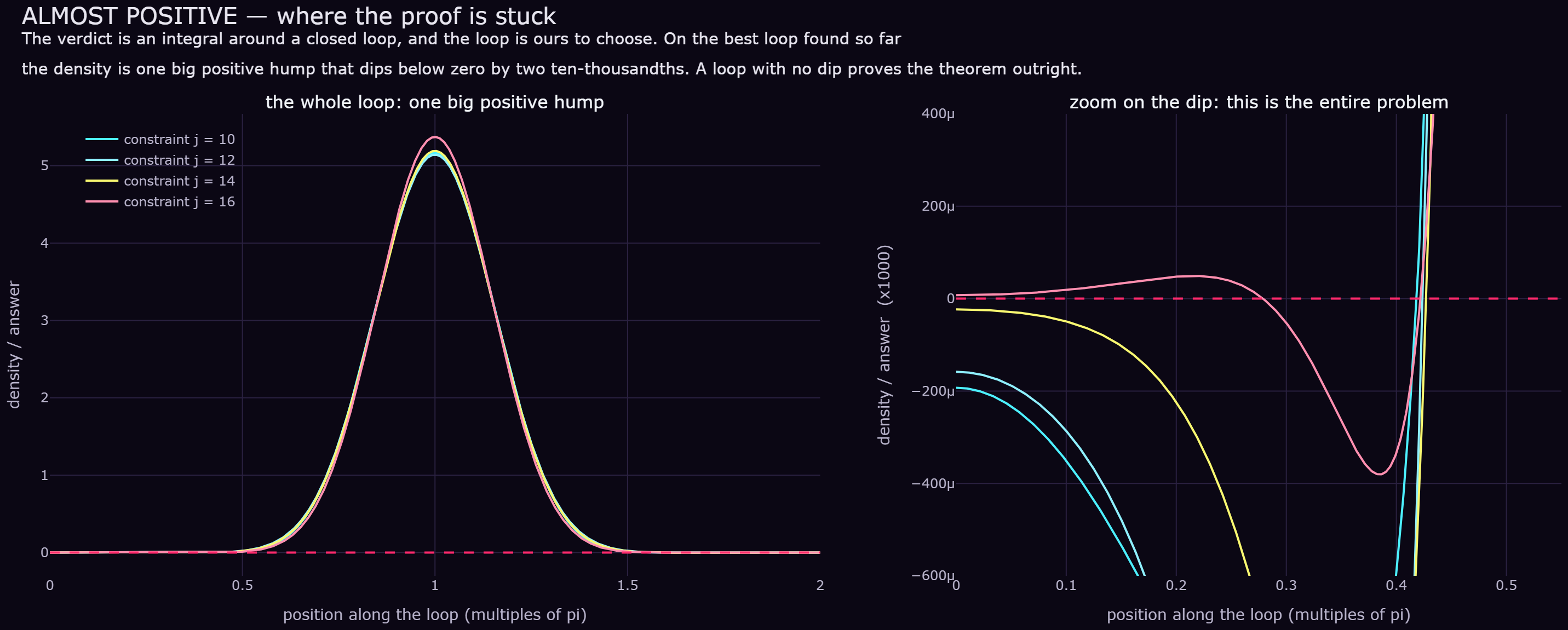
The remaining gap is uniformity in the constraint index. Small indices are settled by machine certificates — currently 1,634 continuous cells covering every level and the whole continuum of the parameter up to about 26. For large indices an asymptotic estimate is needed, and here is the measured obstacle.
The answer turns out to be a difference of much larger quantities. Imagine weighing a ship captain by weighing the ship with him aboard and then without: both numbers are enormous, the difference is small. At constraint index 24, individual contributions are fifty-five times larger than the answer, which survives only through near-perfect mutual cancellation. This is not precision loss — recomputing at 2,000 digits gives numbers identical bit for bit.
Leading-order asymptotics is structurally inadequate there: the leading orders cancel and the answer lives in what remains. The mathematics built for exactly this situation is resurgence and trans-series (Ecalle; Berry and Howls; Delabaere and Pham) — tracking exponentially small corrections across Stokes lines. I do not know that technique yet. That is a gap in my education, not a wall in the problem, and the difference matters: gaps close by study.
Honest status
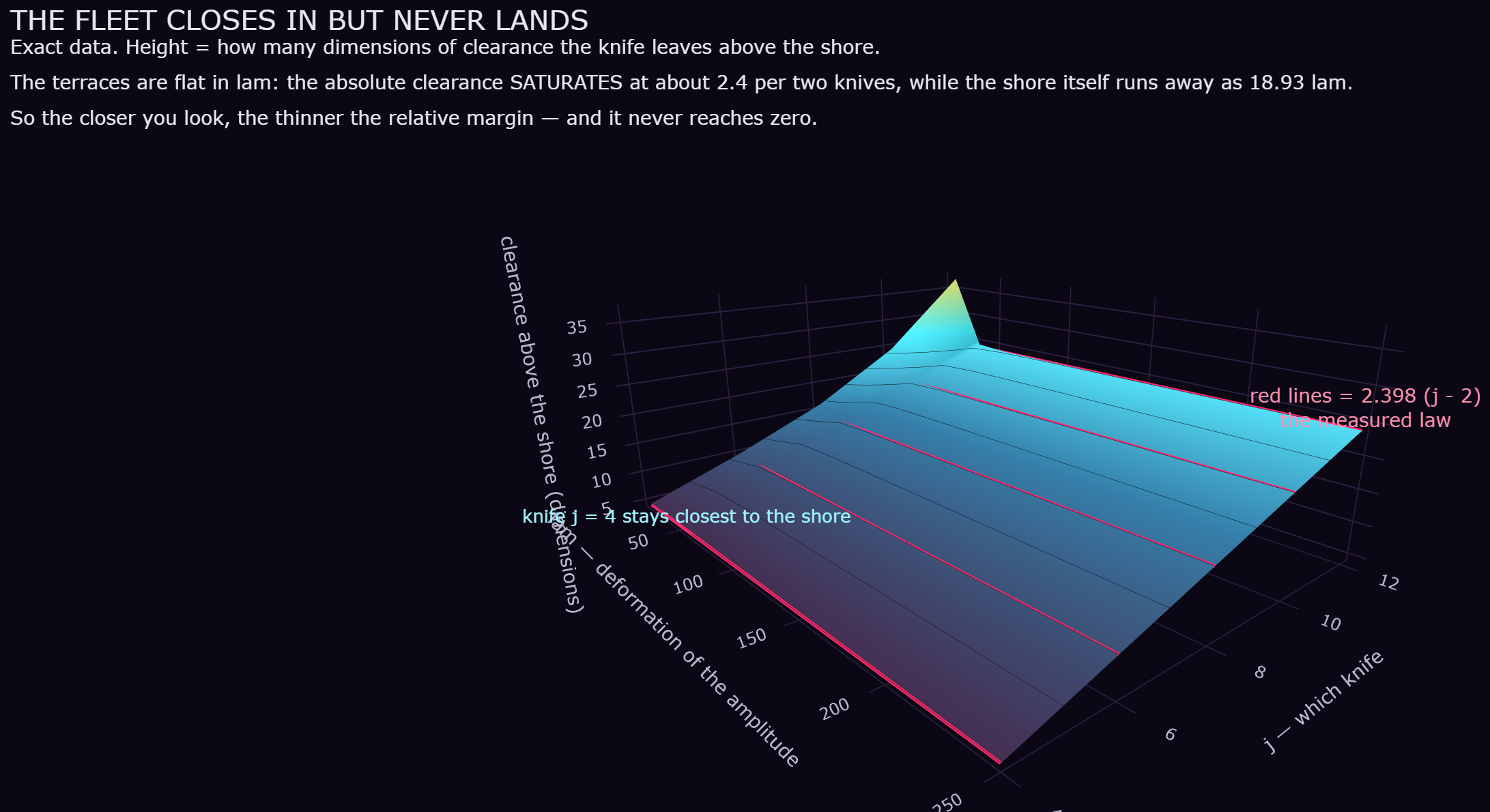
The theorem is not proved and not refuted. What exists: a complete reduction of four parameters to one polynomial, three exact ladders, a proved parity law, machine certificates over a large finite region, 227,040 exact adversarial checks with zero violations, and a named technique for the remaining step. Twenty-eight hypotheses are recorded as dead, with signatures, so that nobody repeats them.
Working notes, artifacts and every failure are in the public repository. Corrections policy: any error gets fixed everywhere and logged.